Demo Video
T1 / Station keeping
Each setpoint compares simulation and pool-trial replays for the Calibrated Fossen policies with and without domain randomization.
T2 · Trajectory-tracking video comparisons
Hardware replays are organized by trajectory. Each comparison places the simulation, recorded top-view trail, and side-view motion for the Calibrated Fossen + DR policy side by side.
Abstract
Underwater robot learning relies on simulators that integrate high-fidelity hydrodynamics, convenient learning interfaces, and a credible transition to real scenarios. In this work, we present FinsSim, a reality-aligned integrated simulation platform for Sim‑to‑Real underwater robot learning. FinsSim first constructs high-fidelity simulation with selectable backends to adapt to diverse requirements. To facilitate underwater robot research, it further offers standard control baselines, alongside with unified robot learning workflows. For reliable Sim-to-Real transfer, FinsSim adopts a multi-sensor fusion scheme to provide low-cost yet precise localization. Moreover, it implements calibrated thruster-hydrodynamics models and constrained wrench allocation algorithm. Bridging these modules by ROS~2, FinsSim establishes a complete Sim-to-Real transfer pipeline. Through matched simulations and experiments, it is demonstrated that reliable Sim-to-Real transfer of underwater robot control policies can be achieved with the FinsSim framework. Separate ablation studies also validate that the modules of FinsSim can address the pivotal issues of underwater Sim-to-Real from different aspects. Overall, this work aims to bridge the gap between theoretical research and practical applications, ultimately driving advancements in the field of underwater robotics.
Specifically Designed for Underwater Robot Learning
Table I summarizes the platform scope reported by the cited primary publications, including multi-agent support, simulation backend, hydrodynamics, ROS, learning interfaces, training parallelism, and Sim-to-Real evidence.
| Platform | MA | Backend | Hydrodynamics | ROS | Learning interface | Parallel training | Sim-to-Real evidence |
|---|---|---|---|---|---|---|---|
| UUV Simulator [1] | No | Gazebo Classic | Fossen-form dynamics | ROS 1 | None reported | No | Not reported |
| DAVE [2] | No | Gazebo Classic | Fossen-form dynamics | ROS 1 | None reported | No | Not reported |
| HoloOcean [3] | Yes | Unreal Engine | Fossen-form dynamics | ROS 2 | Python | No | Not reported |
| Stonefish [4] | No | Bullet / OpenGL | Mesh-based hydrodynamics | ROS 1 / 2 | None reported | No | Not reported |
| MARUS [5] | Yes | Unity | Simplified mesh-based hydrodynamics | ROS 1 / 2 | None reported | No | Not reported |
| MarineGym [6] | Yes | Isaac Lab | Simplified Fossen-form dynamics | None reported | TorchRL / TensorDict | Yes | Not reported |
| UNav-Sim [7] | No | UE5 / AirSim | Fossen-form dynamics | ROS 1 / 2 | AirSim Gym / SB3 | No | Not reported |
| Orca [8] | No | Gazebo Harmonic / ArduSub SITL | Simplified Fossen-form dynamics | ROS 2 | None reported | No | Not reported |
| FinsSim | Yes | Unity / Isaac Lab | Simplified Fossen, calibrated Fossen, physics mesh | ROS 2 | Python / Gym-like, TorchRL / TensorDict, SB3, IL, MARL | Yes | Yes |
Architecture
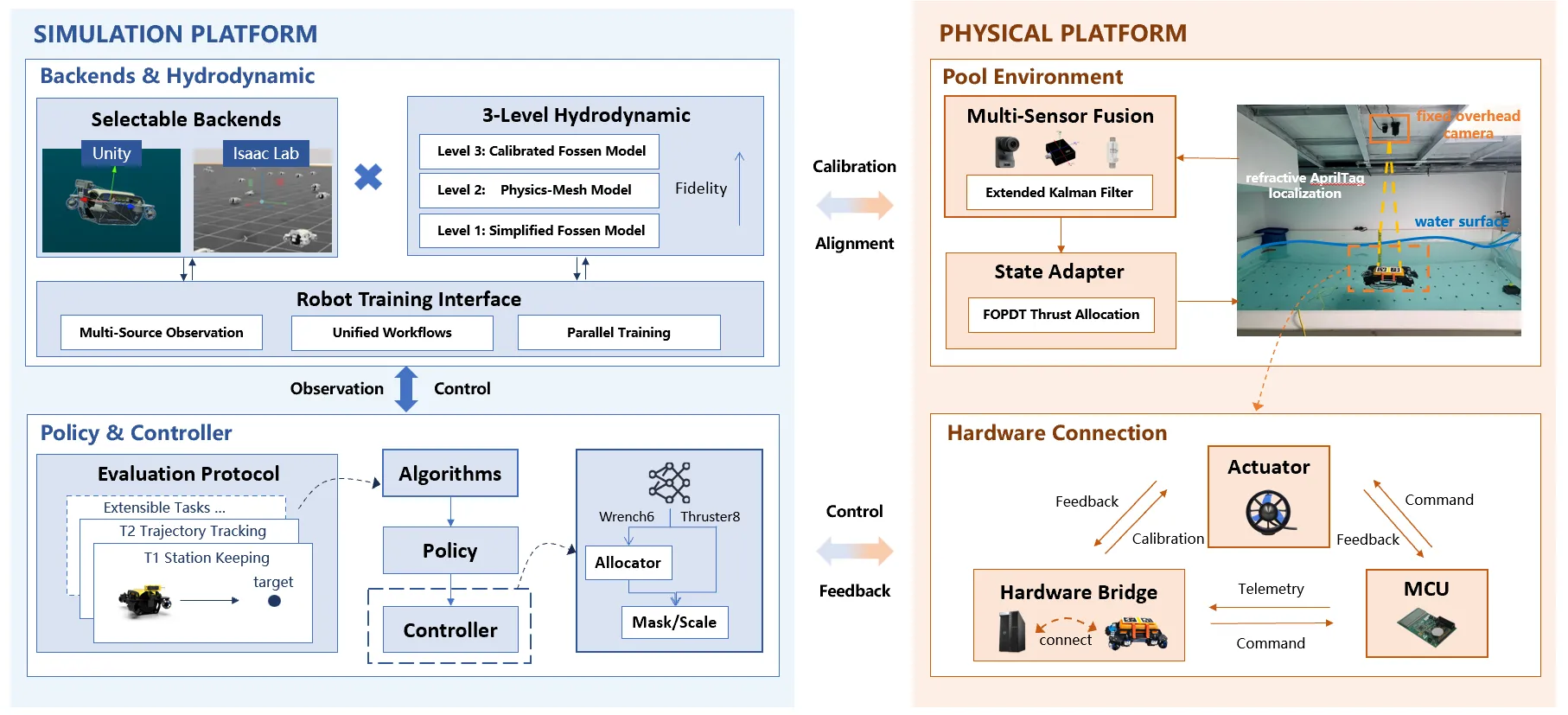
Simulation layer
Unity supplies scene-rich and sensor-oriented simulation, while Isaac Lab provides a GPU-native path for high-throughput state-based training. The vehicle can switch among calibrated Fossen, physics-mesh, and simplified Fossen dynamics.
Learning and control layer
PID, RL, IL, and MARL workflows share sensor, state, action, and evaluation contracts. Policies can operate through a six-channel body wrench or an eight-thruster interface.
Hardware layer
A fixed overhead camera, onboard AprilTags, pressure, and IMU measurements feed a fused state estimate. It’s the perception of the physical world. A hardware bridge and MCU turn bounded force commands into calibrated thruster execution.
FinsSim consists of a simulation platform and a hardware-connected physical platform, linked through ROS 2. The simulation platform supports Unity ML-Agents [10] and Isaac Lab [11] as simulation backends. It provides calibrated Fossen-form, simplified Fossen-form, and mesh-based hydrodynamic models, together with learning and control interfaces for policy training and evaluation. The physical platform combines a low-cost global localization system based on refractive AprilTags, pressure and IMU sensing, multi-sensor state estimation, and a ROS 2 hardware bridge that relays bounded control commands to the onboard MCU for calibrated eight-thruster actuation on FinsROV.
Features
Fidelity-Scalable Simulation
FinsSim provides three interchangeable hydrodynamic models to accommodate diverse simulation and learning requirements.
| Backend | Hydrodynamic model | Characteristics and use |
|---|---|---|
| Calibrated Fossen | [9] | Recommended when vehicle calibration data are available. Single-axis pool trials identify effective inertia, linear and quadratic damping, and bias terms. It gives the closest reported four-axis replay to pool measurements and the strongest reported transfer results. |
| Physics mesh | , | Requires a closed physics mesh. The backend clips the mesh at the water surface and accumulates form and skin drag over submerged faces, making it convenient when mesh geometry is the available starting point for a new vehicle. It can capture geometry-dependent effects, while the reported overall hydrodynamic replay remains less accurate than the calibrated Fossen model. |
| Simplified Fossen | Retains hydrostatics and damping while omitting relative-acceleration estimation and added-mass Coriolis evaluation. It avoids a vehicle-specific calibration procedure; with domain randomization, it supports large-batch RL and parallel training. Its reported replay and transfer fidelity remain below the calibrated Fossen configuration. |
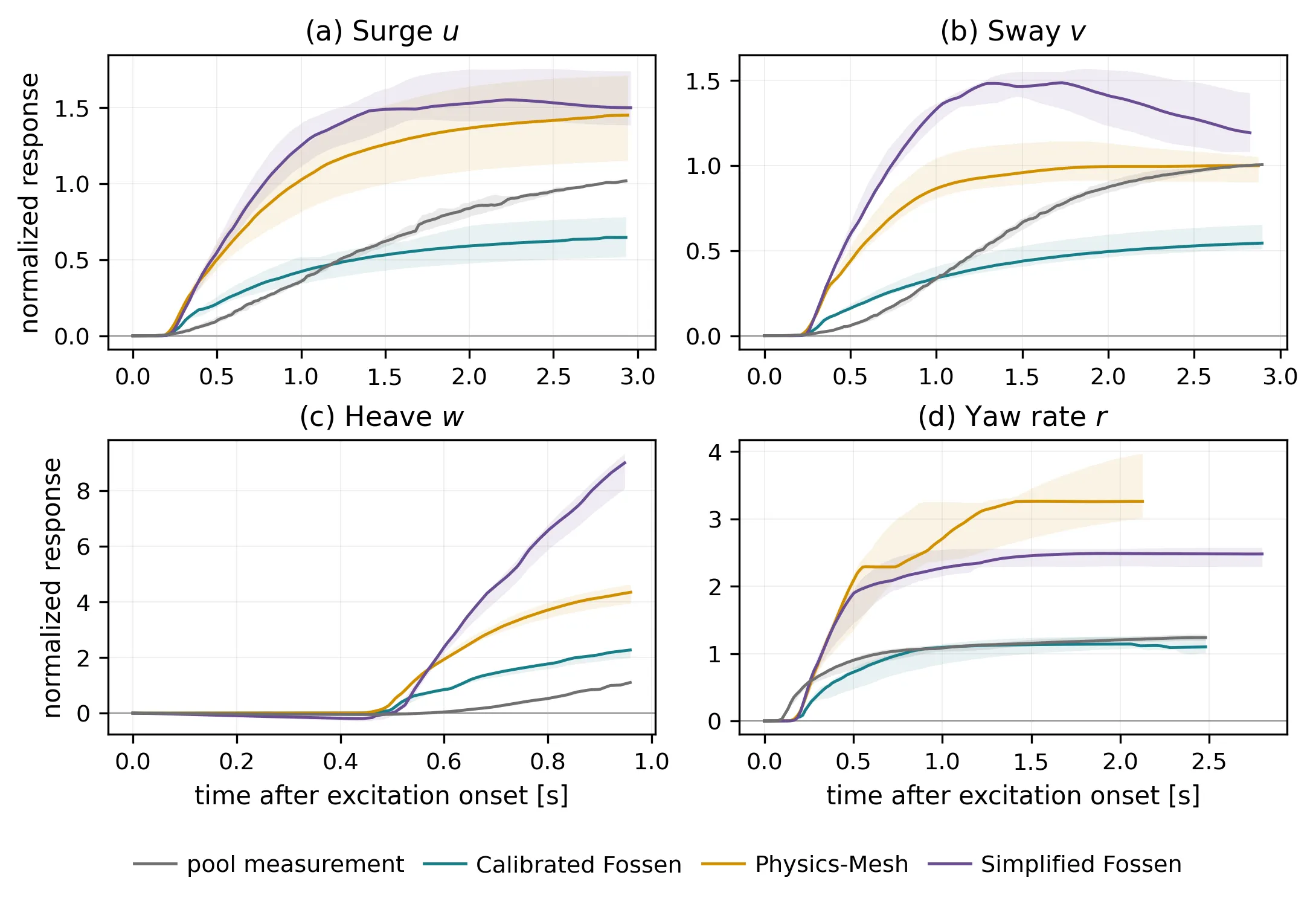
Recorded single-axis pool excitations are replayed in Unity with the three hydrodynamic backends across surge, sway, heave, and yaw. Calibrated Fossen yields the lowest equal-weight four-axis NRMSE and the closest match to the measured physical responses, consistent with the T1 station-keeping transfer results.
| Backend | NRMSE | Bootstrap 95% CI |
|---|---|---|
| Calibrated Fossen | 0.315 | [0.255, 0.338] |
| Physics mesh | 1.104 | [0.923, 1.282] |
| Simplified Fossen | 1.374 | [1.201, 1.447] |
Low-cost Global Positioning
A fixed overhead camera observes two vehicle-mounted AprilTags [12] through a calibrated air-water interface. The camera ray is intersected with the interface, then refracted using Snell’s law before reconstruction at the pressure- and IMU-constrained tag-corner height. This provides horizontal position and yaw, while pressure supplies depth and the IMU constrains roll and pitch.
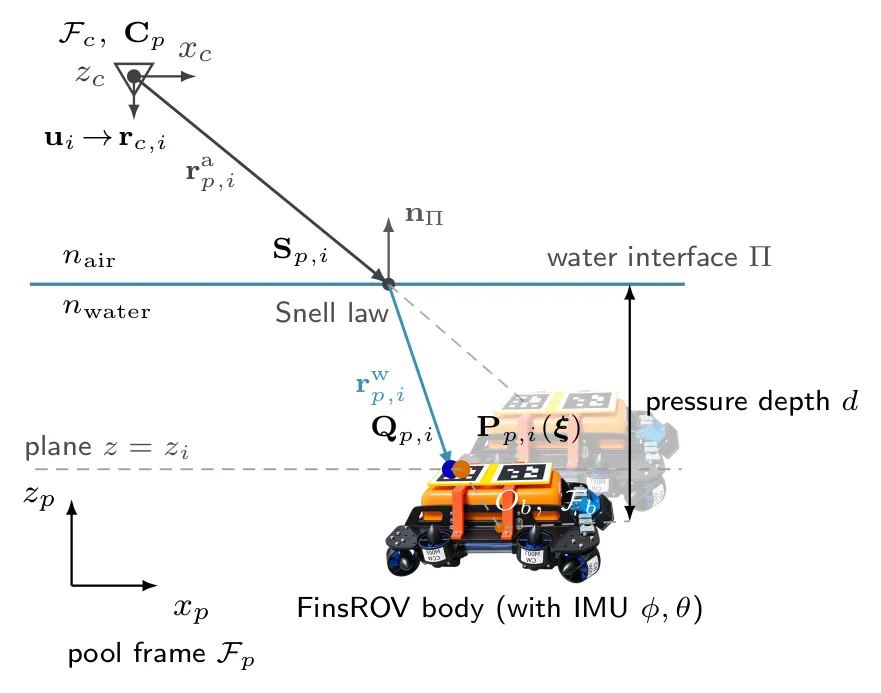
The resulting AprilTag measurement is fused by a position-velocity EKF and a separate yaw filter. Across 720 archived images at 170 surveyed pool locations, the refraction-aware measurement reaches 0.73 cm horizontal RMSE and 1.45 cm P95, compared with 5.74 cm and 11.41 cm for pinhole PnP.
| Method | Infrastructure | Cost |
|---|---|---|
| FinsSim | Overhead camera, 2×AprilTag, IMU, pressure sensor | $101 |
| SBL acoustic positioning | GPS/acoustic base station, antenna, acoustic locator, ROV-integrated component | $8,990 |
| Underwater optical motion capture | Underwater motion-capture cameras, synchronization network, marker rig, calibration tools, software | $118k–226k |
Reality-aligned
FinsSim separates vehicle-specific calibration from task specification. The calibrated vehicle stack includes hydrodynamic coefficients, directional thrust curves, allocation geometry, and safety bounds; the same ROS 2 interface then connects simulation, controllers, and the FinsROV hardware bridge.
Hydrodynamic calibration
Single-axis trials identify effective mass or inertia, linear damping, quadratic damping, and constant bias for surge, sway, heave, and yaw. Roll and pitch use the corresponding restoring-moment model, and the resulting vehicle profile is transferred into the calibrated Fossen backend.
Thrust-curve calibration
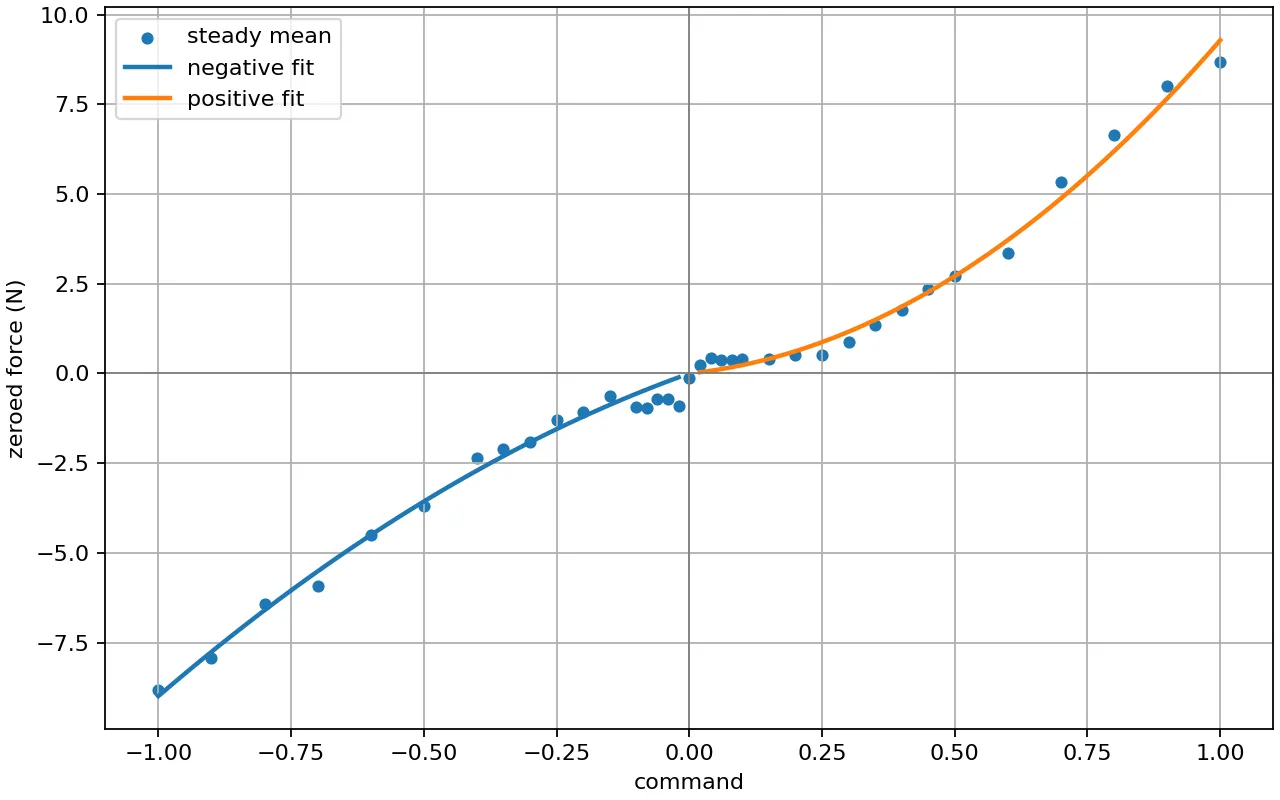
Each thruster uses separately identified forward and reverse steady-state quadratic curves. The bridge maps requested force to target RPM, and the onboard MCU closes a feedforward-plus-PID speed loop using measured RPM feedback.
Bounded hardware execution
For body-wrench commands, a constrained allocator respects calibrated directional force limits and regularizes unnecessary thrust effort before sending the shared eight-channel command to Unity or the hardware bridge.
Learning Task Contracts
FinsSim specifies task-specific observations, normalized actions, reward functions, safety conditions, and evaluation metrics for underwater control. The reported policies use Proximal Policy Optimization [13] through Stable-Baselines3 [14]. PPO-Wrench6 and PPO-Thruster8 share task-specific observations and calibrated force limits while providing distinct action interfaces.
T1 / Station keeping
Hold a registered 4-DOF pose
- Observation
- 16 dimensions: body-frame target displacement, continuous relative attitude, linear and angular velocity, and scalar distance-to-goal.
- Action
- Wrench6 emits a normalized six-axis body wrench in [-1, 1]. Thruster8 emits normalized commands for the eight canonical thrusters. Reported hardware results use Wrench6.
- Reward
- Position tracking and a sustained-hold bonus, attitude and angular-rate preference, low-energy smooth commands, and a penalty on task failure.
- Evaluation
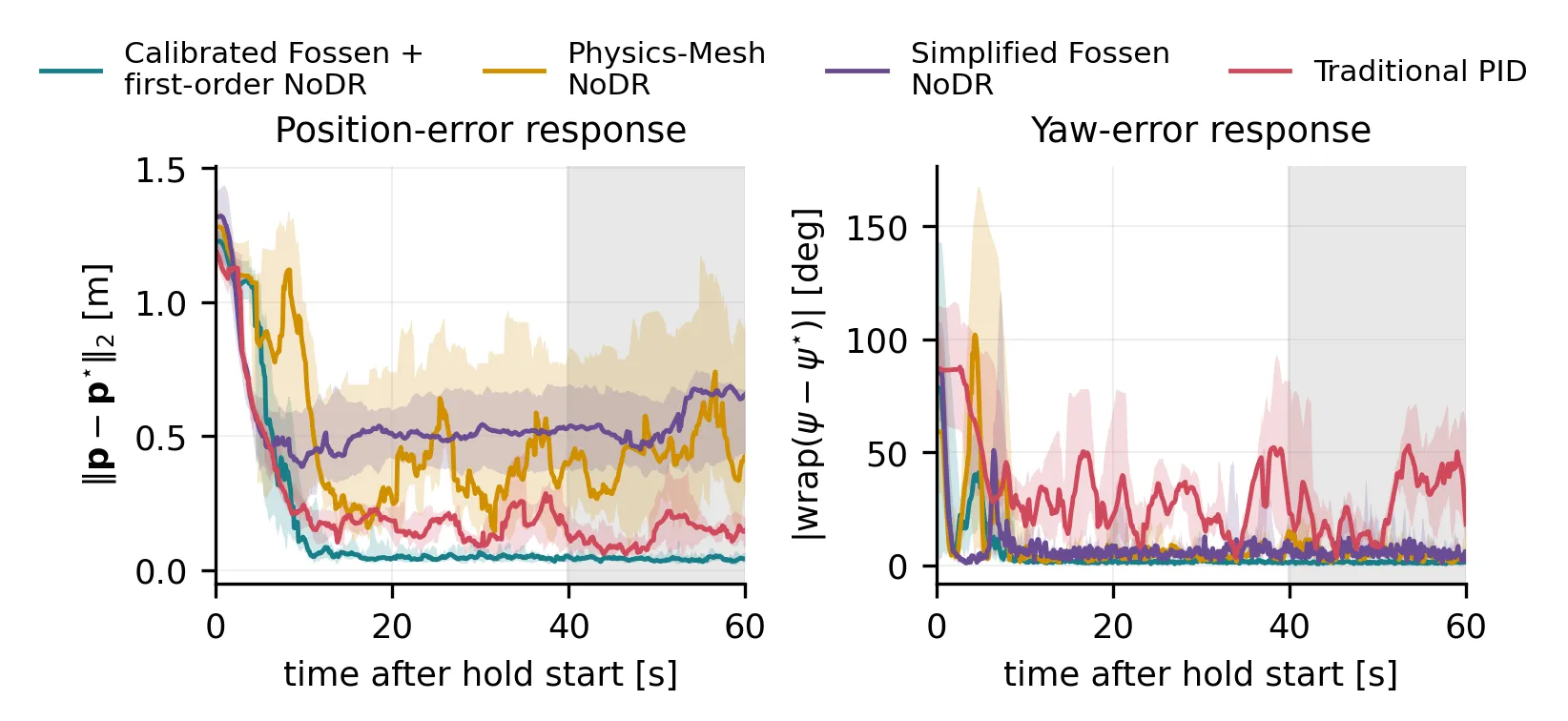
- Eight fixed setpoints, 60 s per trial. Position and yaw RMSE are measured in the 40-60 s late-hold window; roll and pitch are safety guards.
T2 / Trajectory tracking
Follow a time-indexed 3D reference
- Observation
- 30 dimensions: four future body-relative reference points, reference velocity and tangent, vehicle linear and angular velocity, control state, and trajectory encoding.
- Action
- The same Wrench6 and Thruster8 policy contracts are available. Hardware comparisons report Wrench6, which maps a normalized wrench to bounded thruster forces.
- Reward
- Path-tracking quality, uprightness and low yaw-rate preferences conditioned on tracking, low-energy actuation, and failure termination penalties.
- Evaluation
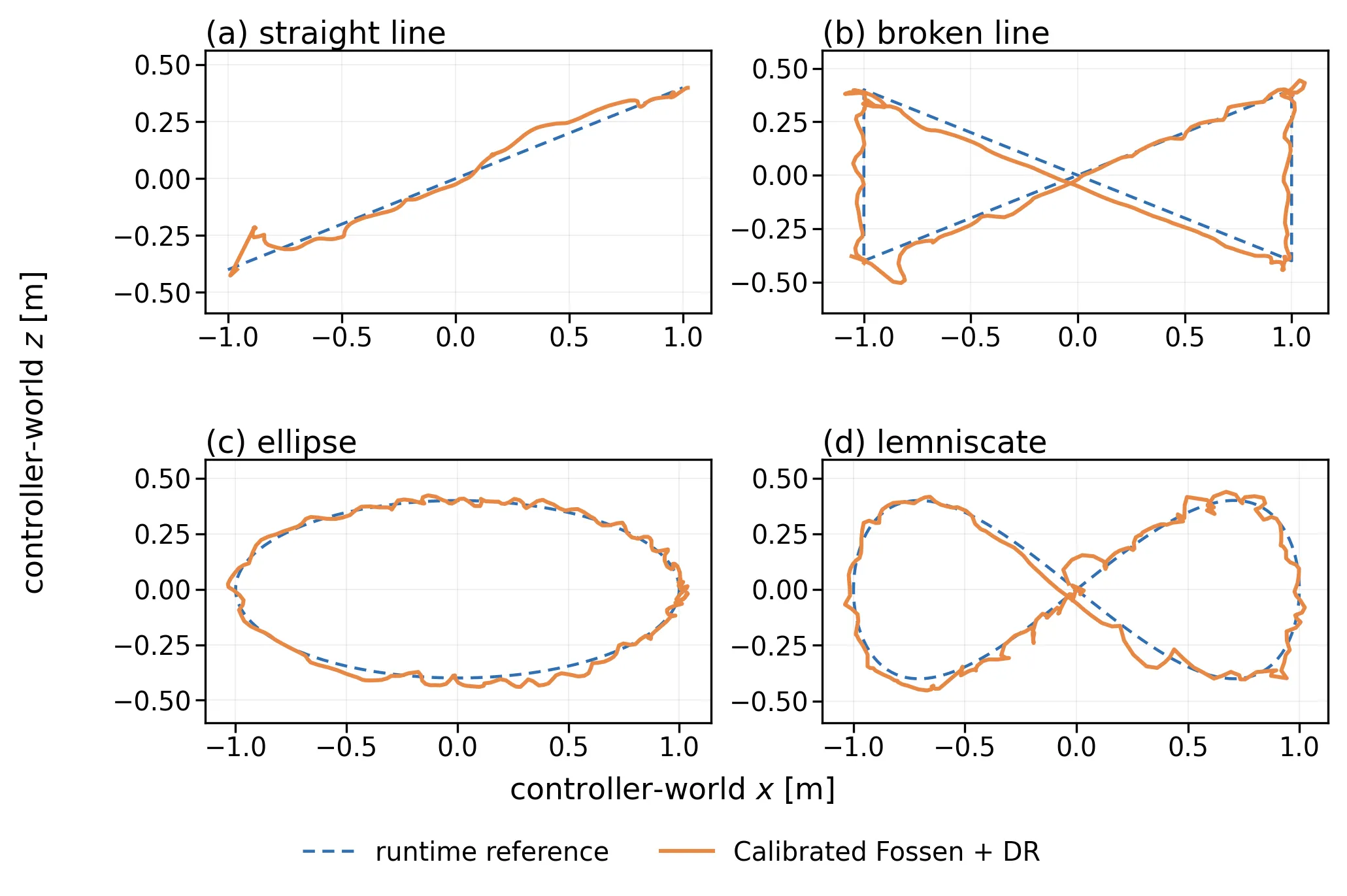
- Straight-line, broken-line, elliptical, and lemniscate references. The task tracks translation, with yaw, roll, and pitch maintained as stabilized axes.
Experimental Results
The experiments evaluate refractive localization accuracy, simulation dynamics reliability, and Sim-to-Real policy transfer through matched simulation and pool trials.
| Configuration | 3D position RMSE [m] | Yaw RMSE [deg] | Success |
|---|---|---|---|
| Calibrated Fossen + NoDR | 0.077 | 6.54 | 7 / 8 |
| Calibrated Fossen + DR | 0.092 | 5.42 | 7 / 8 |
| Physics mesh | 0.746 | 12.19 | 0 / 8 |
| Physics mesh + DR | 0.197 | 8.62 | 0 / 8 |
| Simplified Fossen | 0.598 | 23.37 | 0 / 8 |
| Traditional PID | 0.176 | 44.08 | 0 / 8 |
| Configuration | Trajectory | Horizontal RMSE [m] | Vertical RMSE [m] | 3D P95 [m] |
|---|---|---|---|---|
| Calibrated Fossen + DR | Straight line | 0.068 | 0.129 | 0.409 |
| Broken line | 0.086 | 0.084 | 0.265 | |
| Ellipse | 0.091 | 0.080 | 0.366 | |
| Lemniscate | 0.051 | 0.073 | 0.134 | |
| Calibrated Fossen + NoDR | Straight line | 0.135 | 0.139 | 0.406 |
| Broken line | 0.136 | 0.133 | 0.310 | |
| Ellipse | 0.166 | 0.102 | 0.338 | |
| Lemniscate | 0.163 | 0.103 | 0.305 | |
| Traditional PID | Straight line | 0.182 | 0.146 | 0.405 |
| Broken line | 0.196 | 0.152 | 0.426 | |
| Ellipse | 0.174 | 0.134 | 0.433 | |
| Lemniscate | 0.207 | 0.170 | 0.514 |
Citation
@article{zhang2026finssim,
  title={FinsSim: A Reality-Aligned Integrated Simulation Platform for Underwater Robot Learning},
  author={Zhang, Yu and Song, Yuanmingqing and Rao, Xiangyun and Fong, Pangkit and Zhang, Kunhao and Fang, Chongrong and He, Jianping},
  journal={arXiv preprint arXiv:2609.23943},
  year={2026},
  doi={10.48550/arXiv.2609.23943},
  url={https://arxiv.org/abs/2609.23943}
}
References
- Manhaes, M. M. M., et al. (2016). UUV Simulator: A Gazebo-based Package for Underwater Intervention and Multi-robot Simulation. OCEANS 2016 MTS/IEEE Monterey.
- Zhang, M. M., et al. (2022). DAVE Aquatic Virtual Environment: Toward a General Underwater Robotics Simulator. IEEE/OES Autonomous Underwater Vehicles Symposium.
- Romrell, B., et al. (2025). A Preview of HoloOcean 2.0. arXiv:2510.06160.
- Grimaldi, M., et al. (2025). Stonefish: Supporting Machine Learning Research in Marine Robotics. IEEE ICRA.
- Loncar, I., et al. (2022). MARUS: A Marine Robotics Simulator. OCEANS 2022, Hampton Roads.
- Chu, S., et al. (2025). MarineGym: A High-Performance Reinforcement Learning Platform for Underwater Robotics. IEEE/RSJ IROS.
- McQueen, C. (2022, 2026). orca4 and orca5: ROS 2 AUV software repositories for BlueROV2.
- Fossen, T. I. (2011). Handbook of Marine Craft Hydrodynamics and Motion Control. Wiley.
- Juliani, A., et al. (2020). Unity: A General Platform for Intelligent Agents. arXiv:1809.02627.
- Mittal, M., et al. (2025). Isaac Lab: A GPU-Accelerated Simulation Framework for Multi-Modal Robot Learning. arXiv:2511.04831.
- Olson, E. (2011). AprilTag: A Robust and Flexible Visual Fiducial System. IEEE ICRA.
- Schulman, J., et al. (2017). Proximal Policy Optimization Algorithms. arXiv:1707.06347.
- Raffin, A., et al. (2021). Stable-Baselines3: Reliable Reinforcement Learning Implementations. Journal of Machine Learning Research, 22(268), 1-8.